Case Study

Archer Airboat Tours: I rebuilt the site, then found out it was never actually down

My father-in-law runs airboat tours out of Matlacha: coastal saltwater, dolphins and manatees, not the hour-long van ride to a gator swamp everyone else sells. His “broken” website turned out to be a domain mess hiding a decade of five-star reviews behind a blank page. So I untangled it, rebuilt the whole thing on a stack the family can actually run, and specced a booking system for a captain who loses phones to the water.

The Problem

A real business with a website that had quit on it

The tour has been real for years: five stars on Tripadvisor going back to 2017, an active Facebook following, a captain with three decades on this water. The website had not kept up. What was actually live was a blank builder template, stock photos and placeholder headlines, no phone number, no address, no way to book anything.

Worse, a decade of hard-won review authority was quietly leaking away: the strong domain, the one printed on the reviews and the business cards, had been set to forward into a weaker, emptier one instead of hosting anything itself. The business was not missing a website. It was missing the one it had already earned.

The Strategy

Own the category nobody else was claiming

Every airboat operator ranking near Fort Myers is an Everglades play: load tourists into a van, drive an hour to a gator swamp, drive an hour back. Bobby is the opposite, and nobody else was saying so out loud. He launches right in Matlacha and runs the coastal saltwater: the mangrove backwaters of Matlacha Pass, sandbar walks, and water that is dolphins and manatees and stingrays, not alligators.

So the whole site leans into the lane no competitor occupies: coastal, not Everglades; dolphins, not gators; ten minutes from Cape Coral, not an hour into a swamp. When you cannot out-shout a crowded category, you find the empty one and run your flag up where the whole bay can see it.

The Rebuild

What a visitor actually gets

Rebuilt from a blank template into a real site, on a stack the family can keep running long after I step back. Here is the tour of the tour.

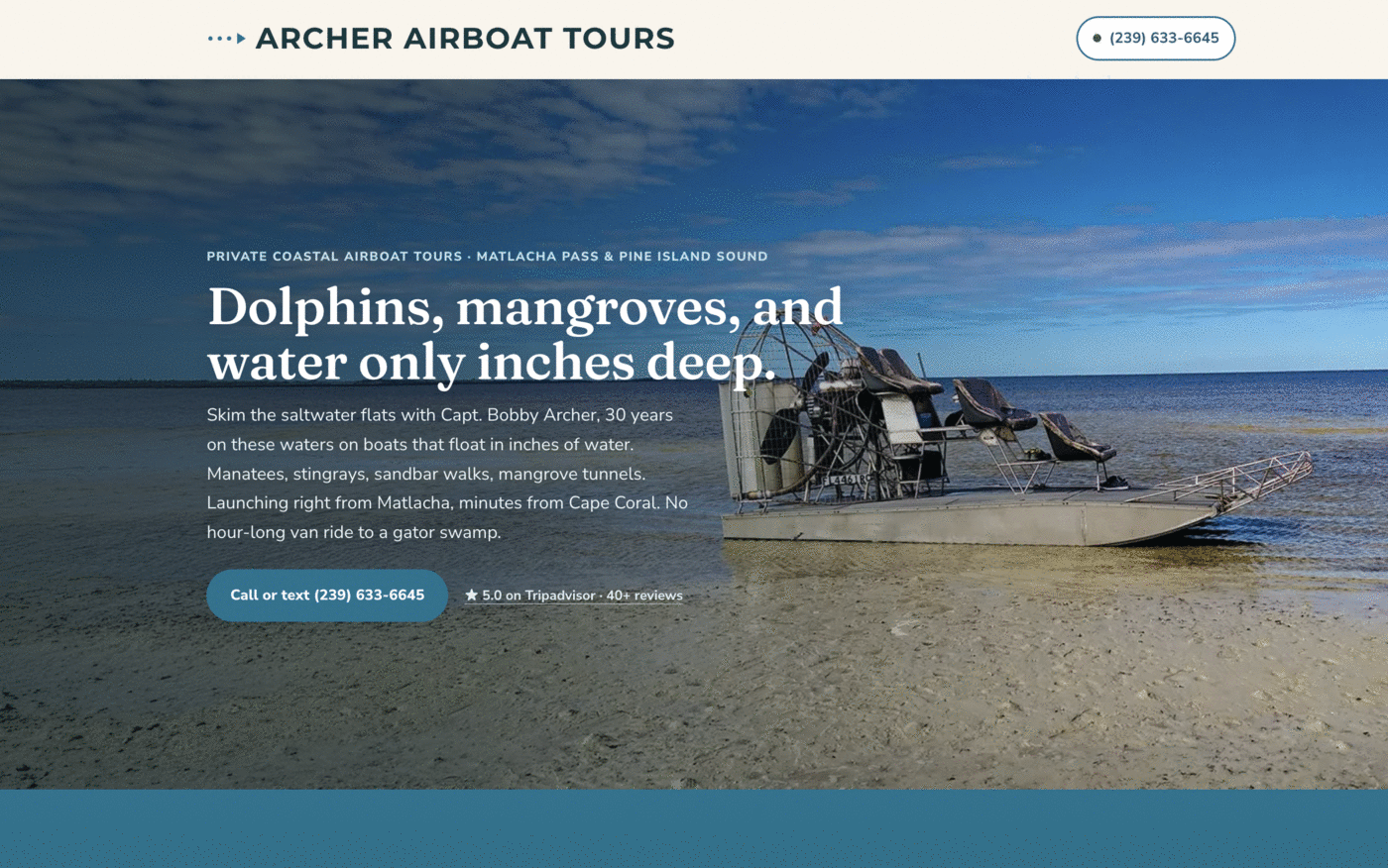
Home hero: coastal airboat on Matlacha Pass
01

The category, stated in five seconds

A visitor lands and immediately knows what this is and what it is not: the hero is a real shot of Bobby’s boat on the Matlacha flats under the headline “Dolphins, mangroves, and water only inches deep,” with “no hour-long van ride to a gator swamp” right below it. Tap-to-call and the 5.0 Tripadvisor rating sit in the same view, so the category, the proof, and the way to book are all clear before the first scroll. Bobby’s own promo clip moved further down into its own “see the backcountry” section, real footage instead of stock, with room to swap in drone and GoPro shots as they get filmed.
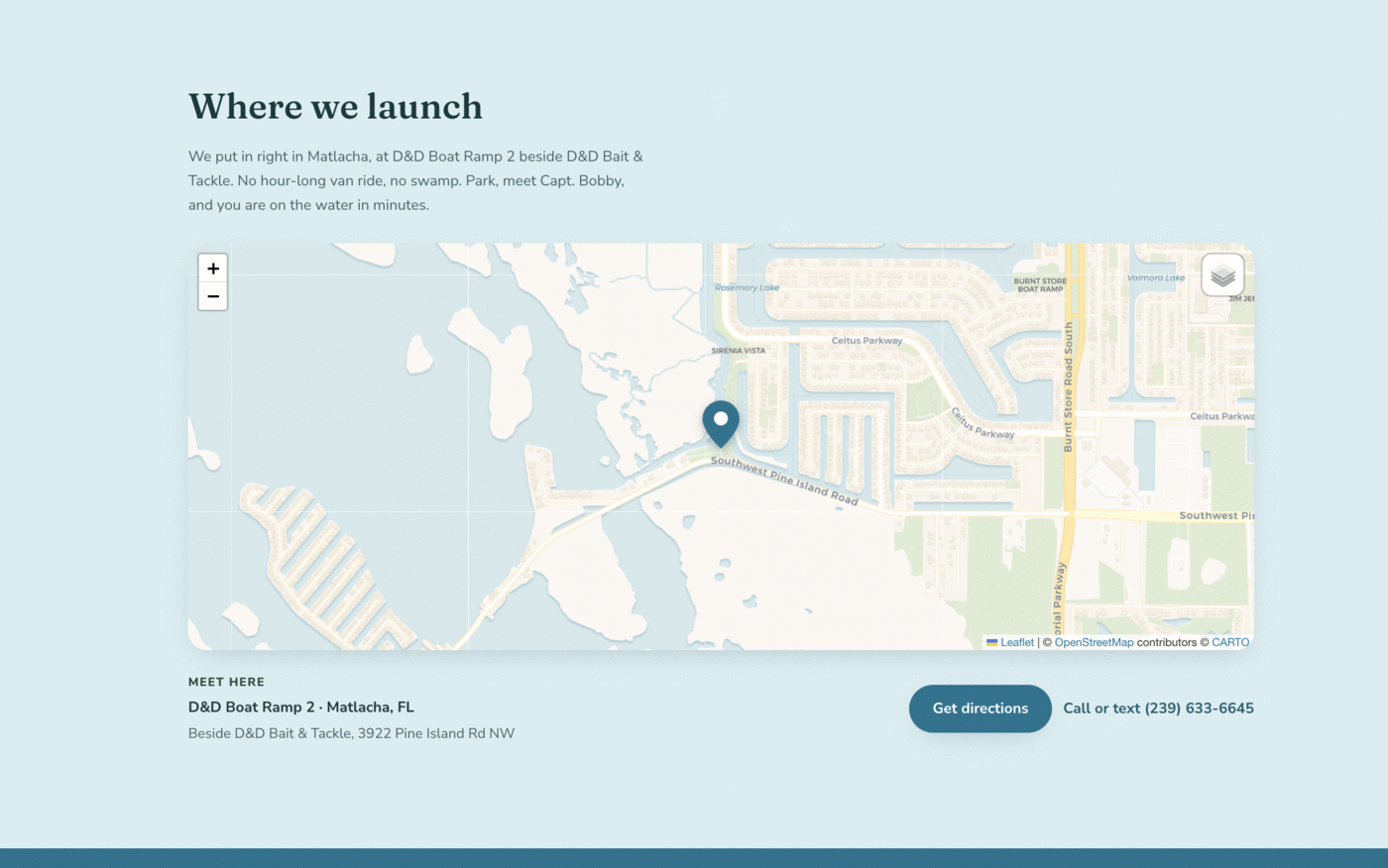
Interactive departure map with Map / Satellite toggle
02

Exactly where to meet, on a map you can actually read

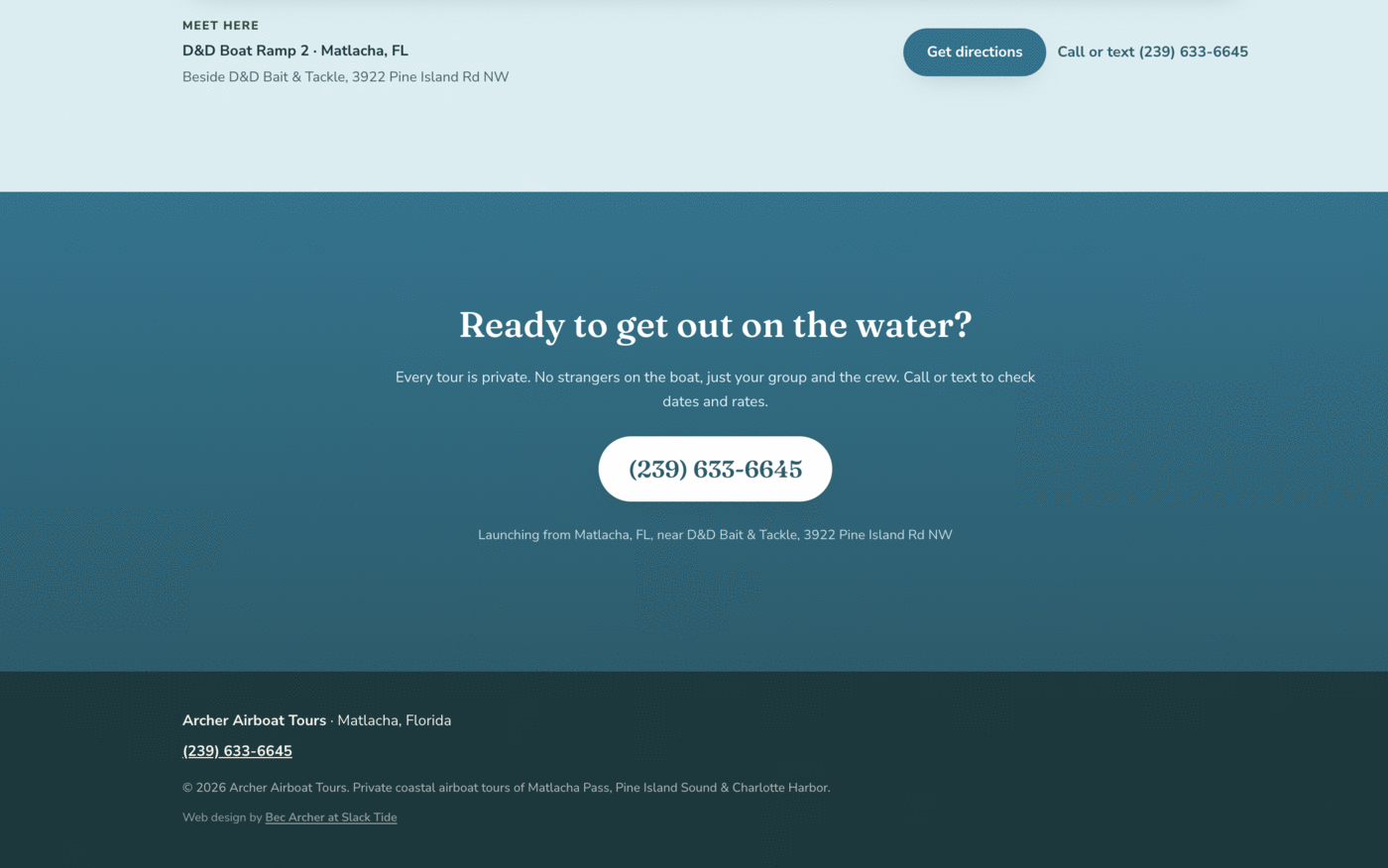
Tourists do not know Matlacha, so “near D&D Bait & Tackle” is not a real answer. The departure map is a live Leaflet map pinned to the boat ramp, with a Map and Satellite toggle (both free, no API key), a Get Directions button that opens turn-by-turn on a phone, and a plain-text address underneath that still works if the script never loads. Nobody circles a marina wondering where the captain is.

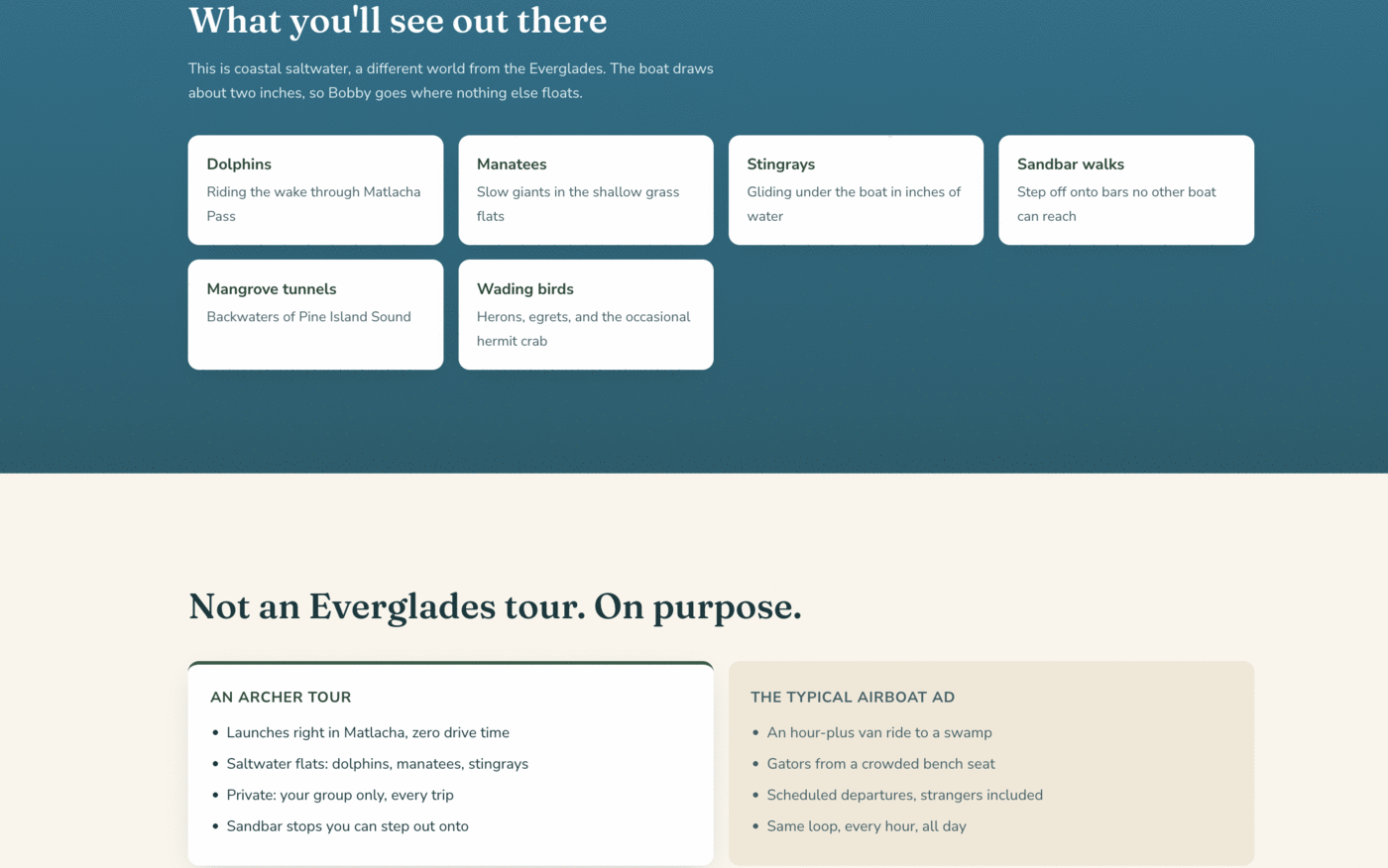
The coastal experience: mangroves, sandbar, wildlife
03

Dolphins, not gators

The whole middle of the site sells the thing no competitor can: the mangrove backwaters of Matlacha Pass, sandbar walk stops, and the wildlife that actually lives out there, dolphins and manatees and stingrays and wading birds. The boats run in a few inches of water and go where nothing else can, so the site says exactly that instead of burying it.

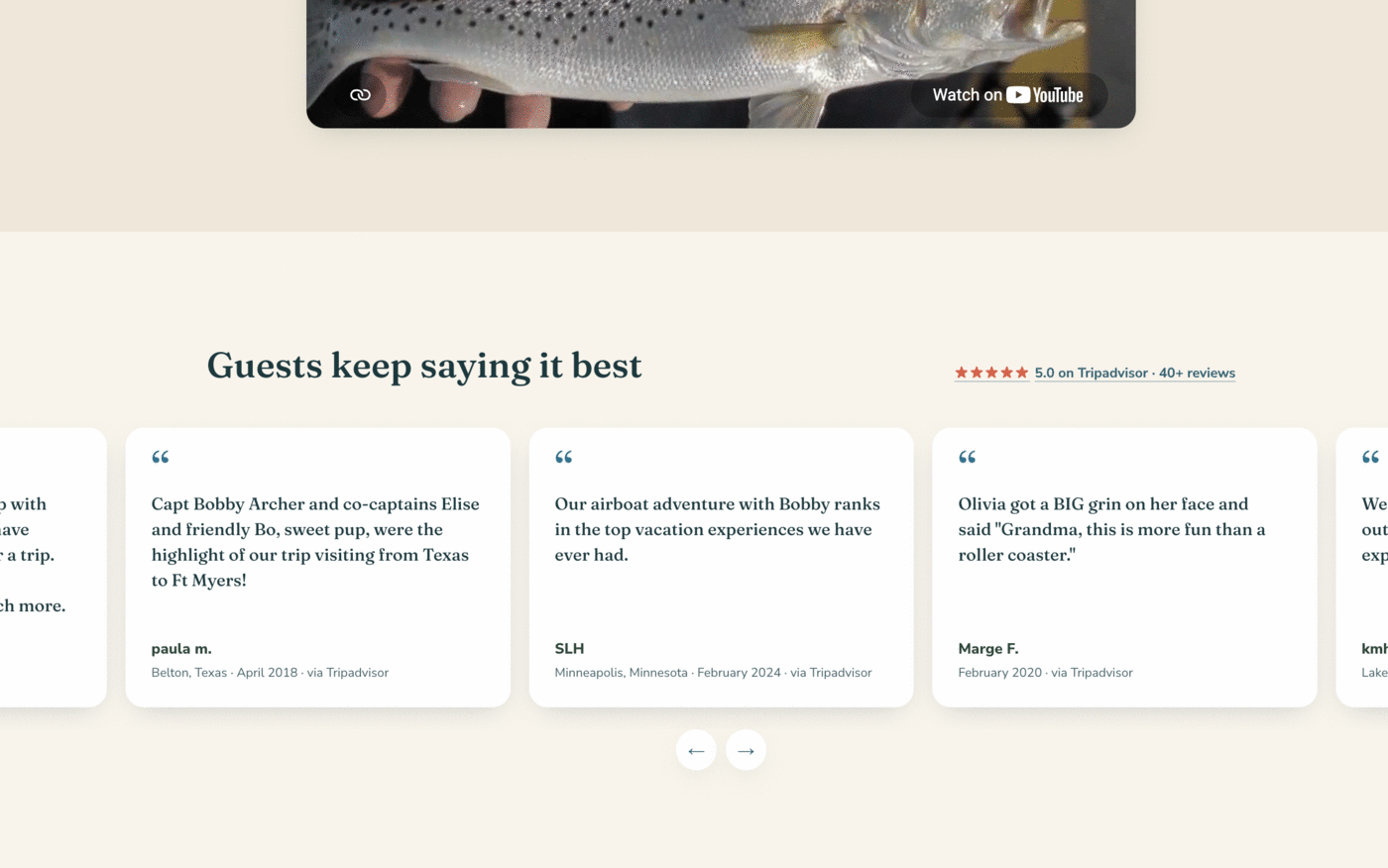
Reviews surfaced on-site (5.0 across 40 on Tripadvisor)
04

A decade of five stars, finally on his own page

Bobby had years of five-star reviews scattered across Tripadvisor and Facebook and nothing on his own site to show for it. The rebuild pulls that social proof onto the page where it does the selling, so a first-time visitor sees the track record without leaving to go hunt for it.

Call-first booking with tap-to-call
05

Call first, book online when they’re ready

Bobby books by phone and keeps a paper calendar, and the site respects that instead of fighting it: the primary action is a tap-to-call button, front and center, because that is how his customers actually reach him today. The online booking flow exists (more on that below), but it stays behind a switch the owners flip when they decide they want it, not when a developer decides for them.

Keystatic content editor
06

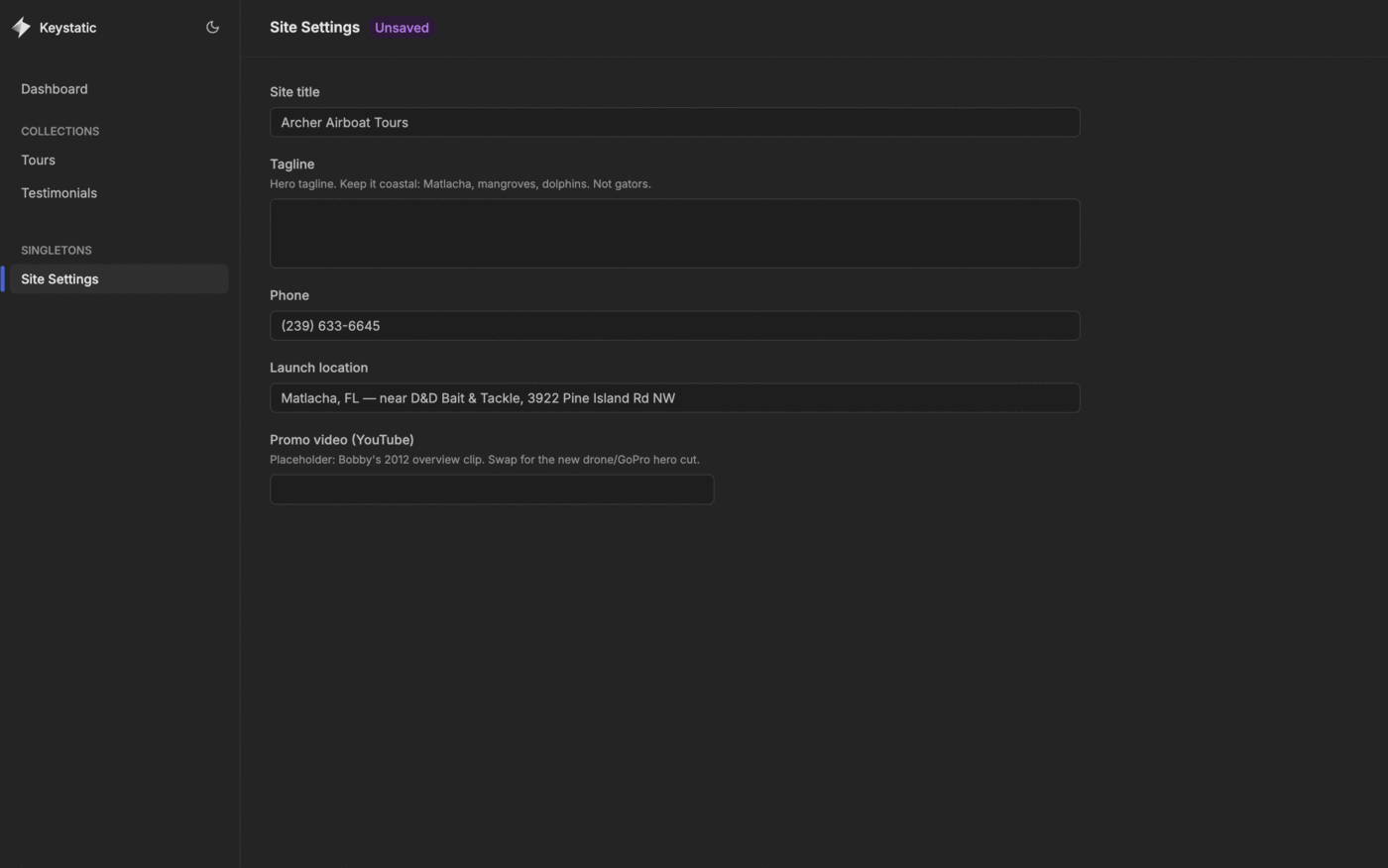
Copy the owners can change themselves

The content lives in a friendly editor, not in the code. Elise can update a headline, swap a photo, or fix a detail without calling me and without touching a line of markup, and every change is versioned in Git underneath. The site is built to outlive my involvement, which is the point of a good handoff.

The System Behind the Call Button

Built for a captain who loses phones to the water

Bobby runs an airboat for a living, which means his phone occasionally runs an airboat for a living too, right up until it goes over the side. So the booking system I specced starts from that fact: nothing a customer books ever lives on a device. Every reservation and every change is written to the database the moment it happens, and the phone in Bobby’s pocket (or Elise’s, or a brand-new one bought that afternoon) is just a window onto it.

Sign-in is a text-message code, not a password nobody will remember and not an email account they may not have, and that same code re-adopts a replacement phone in about thirty seconds. The whole flow is built and waiting behind one switch the owners control. Until they flip it, the paper calendar Bobby has used for years keeps working exactly as it did, because the job was to make his life easier, not to hand him a system he has to babysit.

Under the Hood

The part for the technical readers

Fair warning: this half is for the people who hire engineers. If you are here to get a site built, everything you need is above this line (TL;DR: the site is fast, the family can run it, and the booking system was designed around a real constraint instead of a demo).

AstroKeystatic (Git CMS)CloudflareTypeScriptLeafletSupabasePostgresPhone-OTP authResend emailTelnyx SMSPWA

The database is the boat; the phone is a window

Bobby loses phones to the water, so the booking system starts from that fact instead of pretending it away. Every reservation and every change is written to Supabase the instant it happens; the device stores nothing. A phone that goes overboard loses zero data, because the data was never on the phone.

The phone number is the login

Auth is a text-message code, not a password nobody will remember and not an email account Bobby or Elise may not even have. The same one-time code also re-adopts a brand-new phone in about thirty seconds, so recovery is the login flow, not a separate ordeal.

Email is the alert channel, by Bobby’s call

Bobby wanted new bookings landing in his email, where they stack up in one list he can scroll back through instead of scrolling away like texts do. So email is the default channel now (Resend, from a real Archer address), with SMS built right alongside it, ready to switch on as a second buzz whenever they want one. The system tells him about rides the way he asked to be told, not the way that demoed well.

Online booking behind a switch they control

The full booking flow is built, and it waits behind a single owner-controlled flag. Bobby’s paper calendar keeps working exactly as it did; the online layer turns on only when he and Elise decide they are ready. It is a convenience, never a forced replacement.

Static-fast, with no maintenance tax

The site is Astro on Cloudflare: content in Git, near-zero hosting cost, nothing to patch at eleven at night. It replaced a monthly website-builder subscription with a faster site that does not rot, and killed that recurring bill in the process.

Content the owners can edit, not fear

Keystatic gives Elise a real editor for copy and photos with the code kept safely out of reach. The people who run the business can keep the site current without a developer in the loop, which is what makes a handoff actually stick.

Debugging Story

The outage that wasn’t

The job started as an emergency: the site is down. It wasn’t. The payment had gone through, the servers were answering, the certificate was valid. Nothing at hosting was broken at all. The real problem was three domains wearing a trench coat: a plural spelling, a singular spelling, and the real one. The canonical name (the one on the reviews and the LLC) was forwarding backwards into the empty builder site instead of hosting anything itself.

On top of that, its www version had never been created, so www.archerairboattours.com returned nothing. Every customer who typed the address off the truck or a business card hit a dead end, which is a pretty convincing impression of “down” even though every server involved was perfectly healthy.

The fix was untangling, not repairing: point the real domain at the real site (apex and www both), demote the other two to redirects that funnel their traffic and any stray link equity home, and retire the paid builder plan while we were at it. The lesson I keep: when someone says their site is down, audit the domains before you audit the servers, because “down” is very often three letters, w-w-w, and a redirect pointed the wrong way.